
liza Ritter and Noah Bisbee have known each other since they were toddlers. On any given day in Overlea, Maryland, in the early 2000s, you might have found them running around barefoot, playing out mini soap operas with their dolls.
“Noah’s mom used to chase me with sunscreen,” Ritter says.
Today, the childhood friends are the members of bedroom folk outfit Bloody Crying Twinks, named in 2018 as a cheeky “joke,” says Bisbee, 24. “We were just trying to think of the most hardcore, stupid name we could think of, something that was totally not like our music.”
In less than a decade, the band has released roughly a dozen albums and EPs of refreshingly spare, DIY music. They’ve got a healthy roster of upcoming shows, including a house show March 26, a set at Zissimos March 27, and Slugfest III in Willow Spring, NC, on May 2.
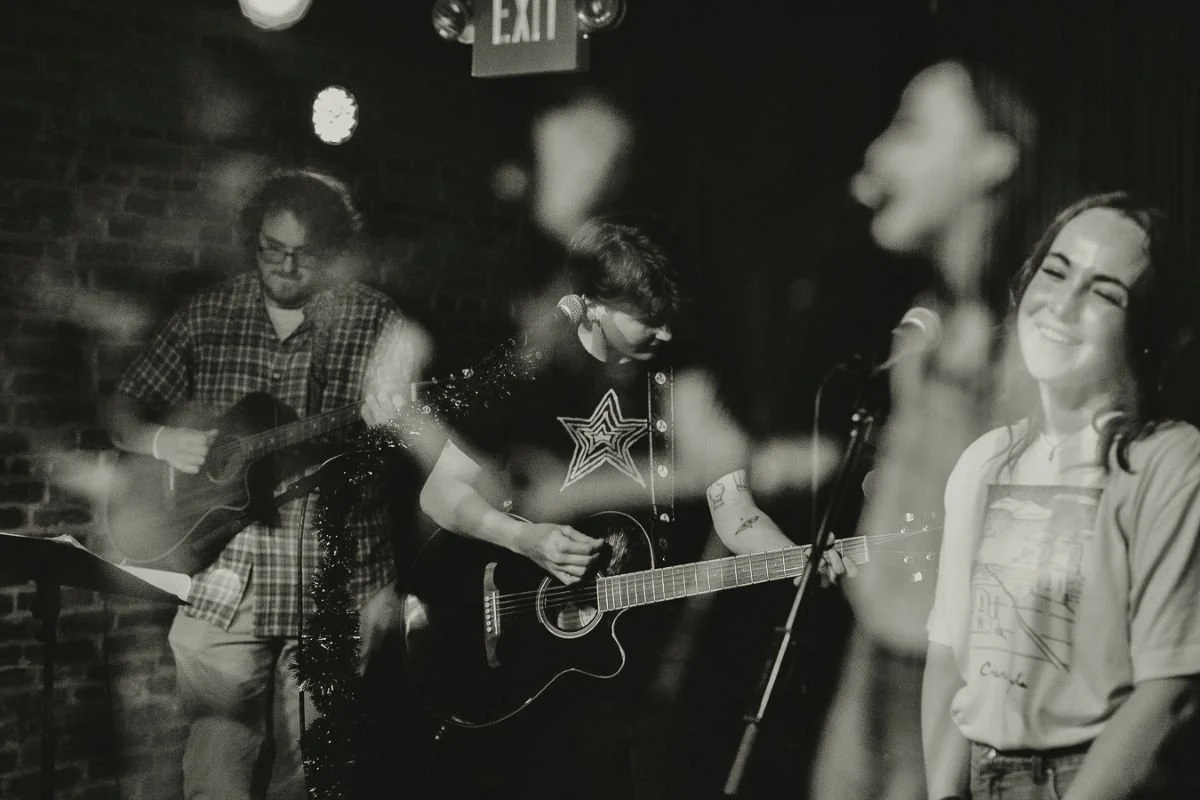
Bloody Crying Twinks at Zissimos, photo by Genevieve Snaps @geesnapsphotos
We were just trying to think of the most hardcore, stupid name we could think of, something that was totally not like our music.
Noah Bisbee
The band formed when they were teenagers and solidified once Ritter was away at York College of Pennsylvania. (Bisbee also studied there for a few semesters.) “In those times we were apart, we could have something to still bring us together, and have a reason to call each other, see each other,” says 25-year-old Ritter.
Both are members of big families and spent large swaths of time playing whiffle ball en masse or writing music and producing primitive videos (with the help of a webcam) as a duo in their basements. Each, coincidentally, was homeschooled, a choice they say was, in part, faith-based.
“For my mom, it was religious,” Bisbee says. “She’s anxious, and I think she didn’t love the time that she had in public school. So she wanted to create a little safe, religious bubble for us.”
With their rough-around-the-edges sound—delicate vocals veering in and out of tune, percussion slightly offbeat, inside-joke giggles sprinkled into the tracks—the band is awfully endearing in the age of autotune and AI. Bisbee says he’s developed a fondness for imperfections in recent years. “These little moments or even mistakes that we leave in are just little pieces of us.”
The homespun vibes have inspired many a comparison to the Moldy Peaches; BCT covered their 2001 track “Anyone Else but You,” featured in the movie Juno, on their latest EP. Ritter takes the frequent comparisons as a “huge compliment”; Bisbee finds them a little vexing but says he’s also “not mad at it.”
The band has been labeled freak-folk and folk-punk, but really is more about the narrative, Bisbee says. “At the end of the day, we’re both just storytellers.”
Ritter and Bisbee take turns writing lyrics, and sometimes write collaboratively, but the words often precede the music. “People assume that what we’re writing about comes from our real lives, but 90% of the time it doesn’t,” says Ritter, who recently published her first short story. “The emotions are real… but the stories are usually just pure fiction that we come up with to entertain ourselves.”
Noah Bisbee at Zissimos, photo by Genevieve Snaps @geesnapsphotos
Eliza Ritter at Zissimos, photo by Genevieve Snaps @geesnapsphotos
How we really even started to do this was because we, as kids especially, had each other as a safe haven, and art as a safe haven.
Eliza Ritter
The pair prefers home recording spaces (a closet, a bathroom) to a studio. Though budget is one rationale, they like a less polished sound. And when a record is ready, they don’t spend months laboring over getting the perfect mix, glossy visuals or an elaborate promotion plan. They just put it out. “We’re kind of impatient people. When we have an idea, it’s better for us to just go for it, full throttle. Otherwise, sometimes we lose interest,” Bisbee says.
Some of their loveliest pieces are lyrically their most simple, such as the 31-word “The Red Door” off their 2022 album Revenge of the Deadnaming Pastor.
The red door / Has opened my eyes before / And I’m confounded by its beauty / When I’m struck by guilt / The taller it builds / And it opens its arms to me warmly
Others, such as the anthemic “Jesus, Mary, Joseph, Doug,” are more complex. Ritter says that piece was based on the time she scoured the aisles for milk at Royal Farms and was followed by a man named Doug who had a lot to share about his life. Rhythmically, the song is kindred spirits with Sinead O’Connor’s “The Last Day of Our Acquaintance.” Lyrically, it’s the kind of song that in the 1980s would have you gobbling up the lyrics on the fold-out cassette insert.
Climbing up Mount Everest / There’s warrants out for our arrest / But we are happy as two clams / To be two lovers on the lam / And I am cutting onions so / If you start crying then you know / That I will hold you in my arms / And I will keep you safe from harm
Their latest LP, last year’s 13 Songs About Monsters, focuses on, well, songs about monsters. It’s a motif that went beyond the freaky and frightful.
“In any monster story, whether it’s literature or movies, there’s always this underlying theme of otherness, and of just all these different things hiding under the surface,” Bisbee says. “We wanted to take a deeper look into those things and feel what the message of those monsters are.”
Ritter says they “could relate,” given that both grew up in rather pious households and are queer. “We were able to… pick out the humanity in each story, which was really important to us,” she says.
Bisbee talks about a “constant fear of rejection,” and says that even though his church wasn’t explicitly shunning its LGBTQ congregants, it didn’t embrace them either. “There was a way that things are supposed to be, and that was very ingrained in me. So it’s taken a lot of work to be able to feel normal about it,” he says. “I still have times where I have to catch myself and really look at myself as a normal person. I think it definitely warps your sense of identity in that way.”
For Ritter, the message was more direct.
“There was a little more, honestly, outright homophobia in the way I was raised. There was a lot of conflict in my family about it, and honestly, there still is,” she says. “That was a big basis for how we got so close, Noah and I. How we really even started to do this was because we, as kids especially, had each other as a safe haven, and art as a safe haven.”
Two decades after they started having fun running around barefoot and serving as amateur cinematographers, they’re still at it. You never know when you might find them in the middle of a harmonica moment or riffing on the opening credits to Friends.
Bloody Crying Twinks in Little Baker Chapel, 2024, photo by Gabriel Hoff @gabe.hoff.photo
Now, more than ever, human art is important. [To] be with each other and share things; it is very important to try to preserve that.
Eliza Ritter
Joy is clearly the glue that has held them together for two decades. Ritter says she also appreciates having a “creative outlet” as someone who’s typically at her desk job. And she loves connecting with their audience. “I don’t know if there’s a better feeling than someone reaching out and being like, ‘I felt a certain way listening to this,’” she says.
Amid the turmoil of the recent political climate, Bisbee sees their music as productive.
“It feels like we’re putting our art to use, putting our voices to use,” he says. “A lot of our frustrations have definitely been a driving force for our art. I think it’s important to share, and it’s really important to have a community, however small. …The best thing that we have right now is just to be able to come together as a little group and share what we love to do.”
Authenticity is BCT’s raison d’être. At a time when nearly everything we see and hear online is curated, edited, polished, and packaged for our optimal consumption, there’s a growing hunger for something messy. Something a little askew. Something real. “Now, more than ever, human art is important,” Ritter says. “[To] be with each other and share things; it is very important to try to preserve that.”
Tucked into the middle of 13 Songs About Monsters is a song you might otherwise miss, “I Want to Live.” It’s sung candidly, with a bit of twang.
Well, you can’t bring the money with ya / And your body just rots away / And gods don’t have much pity / For people who never pray / And my, those jewels are pretty / And how those lovers loved / And I can’t take it with me / I’m leaving it up above
Ritter says it’s about a mummy. But it’s also seemingly about living your life—however imperfect—while you still can.