
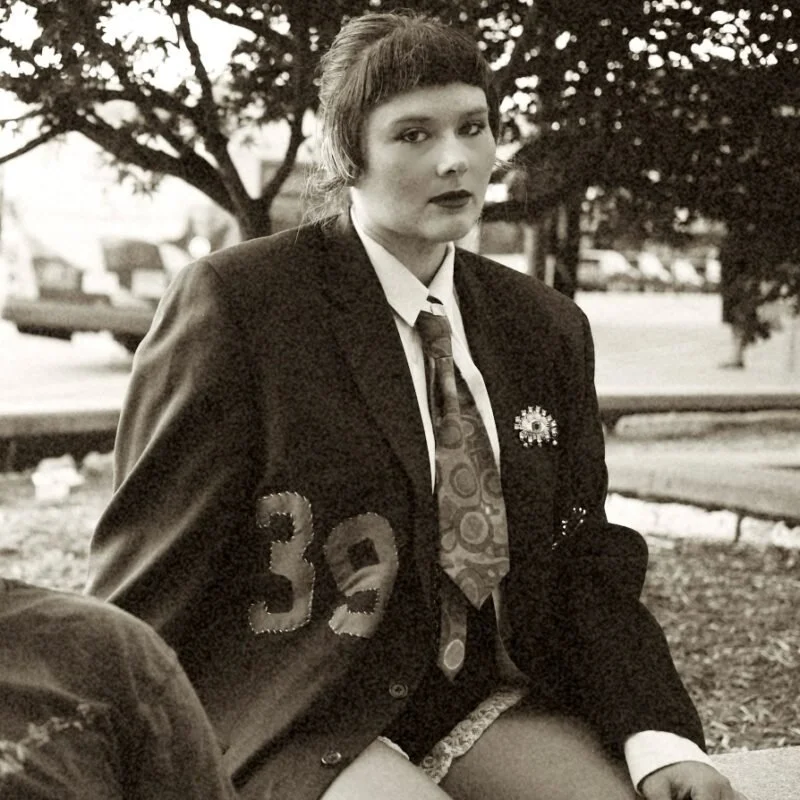
Shelby Morgan is a leap year baby. From birth, she’s been rather different from others, a trait she now regards as an asset.
When the 29-year-old Bowie native steps into the glow of the stage lights, she’s distinctive. Wearing fishnets, sequins, and men’s ties. Her wide bangs cropped short and fuschia shadow swept across her eyelids. Kneeling and jumping and spasming with a winkas she moves from one kinetic pop song to another. She lives for performing, and certainly doesn’t mind if you’re watching while she does it.
Yet Shelby Hall, her given name, isn’t nearly as unrestrained. On a recent Tuesday morning, she was affable but reserved. Wearing little to no makeup and revealing none of the sauce that shows up on stage.
After living in Baltimore for two years, Hall recently moved back to Bowie to help care for her grandmother. Hall suffers from insomnia (so badly she named her vintage shop after it) as well as reverse seasonal affective disorder, causing overheating and debilitating migraines in the summer.
But she finds comfort on stage. Hall has released music as Morgan since 2017, including 2024’s Confessions of a Drama Queen. In February, she plays Ottobar (Wednesday, the 11th) and Metro Gallery (Friday, the 13th) with an April album release show in the works for her latest record, Why Wouldn’t I Want to Put it on Display? And she’s “manifesting” a UK performance sometime this summer.
Eliza Tebo: How do you see yourself as an artist?
Shelby Morgan: I’ve always been very intrigued with vintage and sustainability, and tried to strive for creating music that feels nostalgic and is also sustainable.
What is “sustainable” music?
There’s some music that makes sense for the time we’re in now, but then in a couple years down the line, it might not make sense; it might not fit. There’s something beautiful about letting something age. I want to make something that years down the line can still have its moment and still be relevant and have another resurgence.
How do you do that?
I take a lot of inspiration from the music from the ’60s, ’70s, and ’80s, because I think there’s something special about how they made music back then. They didn’t have social media [like] today, where people are constantly posting music, and you’re hearing it every day on your phone, whether you like it or not. Subconsciously, you—as a songwriter—sometimes end up trying to match what everyone else is making, what’s trending right now.
You mentioned a couple times wanting to be different. I’m curious to learn more about that, as you didn’t say ‘I am different.’
There’s so many people doing the same thing—Taylor Swift, Sabrina Carpenter, these pop girls who are thriving right now—and everyone wanting to be at that level of recognition. I just think that’s really boring. I think about Cyndi Lauper, who was wild; she had bright orange hair. She wore crazy, funky outfits. [Or] fashion designers, Vivienne Westwood, Jean Paul Gaultier, even Madonna. People who didn’t fit the mold ever and just did their own thing. It was authentic.
I’ve felt different my whole life, and I think that’s why a lot of people never really understood me. It just boils down to authenticity, and that’s something I’ve had to really work up the courage to be as a person. [It showed] up in how I would dress. But it took a long time for me to actually do that in my music because growing up I was afraid I’d hurt someone’s feelings. I was a people pleaser.
Is there a way in which ‘Shelby Morgan’ is more freeing, like, I’m going to go fully into this space?
One hundred percent, especially when it comes to performing my original music and making the whole show an experience in some way. That’s 100% alter ego. If I do cover gigs, I feel like I’m doing the cover gigs as Shelby Hall. It’s like a Hannah Montana/Miley Cyrus thing.
You were talking about what’s working for these female pop singers. What are your thoughts on using sex and sexuality to try to build a broader audience?
I’ve never been a fan of doing that, but I also understand. There are times where I’m making a song and I’m like, “I feel really sexy,” and I want to do something with that visually. But it’s never to sell it.
There’s something really liberating about performing, and I think sometimes you can’t help for [sexuality] to come out as a female. Sometimes I feel a little bit more masculine and sometimes I feel a little bit more feminine. Being able to bring that out and really go all in with my femininity—I think it’s fun. And hopefully it’s encouraging for other people who maybe don’t feel very feminine, like, “You can do it, girl.” As long as it’s tasteful and not done for the wrong reasons—if you’re doing it for yourself and not for other people.
Tell me about your first music performance ever.
When I was little, I’d always make my parents watch me in the living room. As a child, on these little vacations to Lancaster, or Massanutten—these random wilderness vacations we would go on—I’d be like, “Karaoke night’s tonight!” And someone in the crowd would see me and be like, “You’re going to be the next big thing.”
Do songs ever come to you in dreams?
It’s always when I’m trying to fall asleep, hence insomnia.
You put out a song called “Favorite Songs.” What are your favorite songs by other artists and yourself for the following situations: to celebrate, recover after heartache, or play in the car.
To celebrate: “Walk of Fame” (Miley Cyrus) and “Microdose” (Shelby Morgan) That’s about microdosing your own happiness.
To recover after heartbreak: “Just Like Heaven” (The Cure) and “Clover” (Shelby Morgan)
To play in the car: “This Must Be the Place (Naive Melody)” (Talking Heads) and “Places” (Shelby Morgan).
What led you to write a song about Lizzie McGuire? How old were you when that was on?
Like 4 or 5. I wasn’t allowed to watch a lot. I really could only watch Disney Channel.
Why was that?
My dad was just very strict. He grew up in a very strict Baptist family, and I think he just really wanted to keep us in a straight line.
Lizzie McGuire, so it’s funny. In 2023 I had gotten broken up with, and we were still going to try and be friends. I released my album Confessions of a Drama Queen in early 2024, [and] they came to the show. After that, I was ghosted. Then I received a letter on my porch. There were a couple songs at the end of Confessions I had written right after the breakup and added on the album. And in the letter, there was a part where he was calling me immature, like, “For you to monetize our relationship is some Lizzie McGuire immature moves,” something like that. I just thought that was so funny. And my mom was like, “You have to write a song about that.”
Have you sent it to Hilary Duff?
I have not. I have tagged her.
Maybe you should take the extra step in 2026.
I know. I need to try.
You said that growing up you were forgotten about a lot. Do you mean in general, or just that your birthday was forgotten?
In general, which is why I think I kept to myself so much and would pretend I was a pop star in my bedroom and write music. I would use my imagination a lot and play by myself. And I got bullied a lot in school.
Confessions of a Drama Queen—is that how you see yourself or how others see you, or neither?
It’s how others saw me growing up, because I was a super emotional kid. And so when I was doing inner child healing work, I was like, “I need to make a song that’s satirical in the way of like, these are the names that I was called—which crushed me as a kid—but as an adult, I kind of want to embrace it and just be like, “OK, if, if that’s how you see me, I’m just going to go all out.’”
This is my therapy, writing about what has happened and being honest about it and not holding back anything. It was an album that I gave as a birthday gift to my younger self; that’s why I also released it on my actual leap-year birthday—so my album and my younger self could share a birthday.
I want to talk about your makeup. It’s really rad. Who are your biggest inspirations?
Chappell Roan. Love, love, love, love how she does her makeup. But any drag queen really inspires me. I also take a lot of inspo from people in the ’80s; a lot of the suit outfits and stuff I’m doing right now were inspired by Annie Lennox, and the orangey blush. There’s an artist named Caroline Kingsbury who’s doing a really cool ’80s thing right now too.
Where’s all this going? In your most daring of dreams, where would you like to end up as a musician?
I just want to connect with more people and tour as much as possible, and just be able to have this be a sustainable and lucrative dream. Right now, I am living my dream but it’s hard to make a living. But that’s the ultimate goal, because I don’t see myself doing anything else.
This interview has been edited for length and clarity.